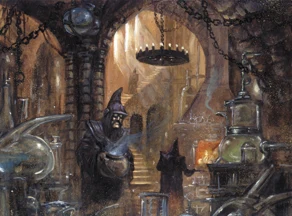
Laboratory
Basic Info
- Type: Action
- Cost: 5
- Effect: +2 Cards / +1 Action
Rating
The poster child for Dominion's "pure cantrip drawer." Non-terminal (+1 Action) with +2 Cards means it grows your hand by 1 without spending Action capacity — an exceptional engine stabilizer. Cost 5 for +2 cards is solid value.
Laboratory's strength is its "chainability" in engines. Each Lab play grows hand and preserves Actions; with 3-5 Labs your hand snowballs until you draw the deck. Unlike Village-Smithy engines, no separate village support is needed — Lab is self-sufficient. Construction is simpler.
But cost 5 means it's only directly affordable on a 5/2 split in the opening. Standard play is to acquire 2-4 Labs over the mid-game. A Lab-centric engine can run on "Labs + minimal terminals," among the cleanest engine constructions.
Overall A to S tier. Among Base's strongest cost-5 cards, rivaling Witch.
How to Play
5/2 opening: Laboratory is a top candidate. Competes with Witch / Remodel / Sentry, but engine plans usually pick Lab. On 4/3, aim for Lab on turn 3-4 by stacking Silvers.
Mid-game, target 2-4 Labs. Two Labs = +4 cards / +2 actions; three Labs = +6 cards / +3 actions. Lab alone covers village function, though 1-2 Villages can supplement when extra Action capacity is needed.
End-game: more Labs vs Provinces. Reliable draw → Provinces. Stalled hands → 1-2 more Labs.
Key Combos
Lab + Smithy: Lab gives +2 cards / +1 action, then Smithy +3 cards = +5 cards total in one Action slot.
Lab + Witch: Lab finds Witch, then Witch fires every turn. Spare Actions handle both reliably.
Lab + Chapel: Thinning makes Lab easier to find. 2-3 Labs + 1 Chapel = thin fast engine.
Lab + Throne Room: TR + Lab = +4 cards / +2 actions. Effectively "Super-Lab," seamless terminal chaining.
Lab + Market: Lab and Market are both non-terminal drawers. Stacking both creates a snowball super-engine.
Synergies
- Smithy: Lab finds, Smithy draws more.
- Witch: Lab draws Witch reliably for cursing.
- Chapel: Thinning + Lab is a clean engine.
- Throne Room: TR + Lab = Super-Lab.
- Market: Co-engine for non-terminal drawing.
- Council Room: Terminal +4 draw; Lab Actions chain it.
- Remodel: Convert obsolete Lab → Duchy (cost 5 → 6).
- Militia / Bandit: Lab supports stable terminal attacks.
Counters & Bad Matchups
- Big Money strategies: Lab dilutes Big Money slightly but Lab-BM is among the simplest viable strategies (~1-2 turns faster than vanilla BM).
- Hard-to-reach 5: Weak Treasure boards delay Lab.
- Better drawers: Library, Wharf, Hireling — sometimes outclass Lab.
- TfB targeting your Lab: Procession trashes Lab itself.
Related Cantrip Drawers
- Caravan (Seaside, 4): Duration version, similar.
- Fishing Village (Seaside, 3): +1 action + duration, no draw.
- Worker's Village (Prosperity, 4): +1 / +2 actions / +1 buy.
- Hireling (Seaside, 5): Permanent +1 card forever.
- Scholar (Renaissance, 5): Discard hand, draw 7. Different feel.
- Travelling Fair / Cartographer / Hostelry: Various conditional draws.
Pure "+1 action / +2 cards" cantrip drawers are Lab's signature. Most expansions have variants with added effects (durations, conditions).
Advanced Tips
Lab is "draw count = play count" so deck density stays constant. 100 cards with 3 Labs means hand grows each time a Lab hits.
Play order: Lab first, then other actions — Lab's draw might reveal more options.
Engine math: Lab counts as "+1 draw, 0 action slot." Functionally similar to Village (+1 draw / +1 action) but specialized in draw scaling.
Lab-centric engines scale with deck thickness. Thin decks → 2 Labs suffice. Thick decks → 5+ Labs may be needed.