Complete Winning Guide
Complete guide on how to win at Heart of Crown. Three-phase management, maximizing succession points, end-game control, responding to opponents. Victory routes for all princesses.
The Three Elements That Decide Victory
Winning at Heart of Crown comes down to three core factors. Understanding these is the starting point for all strategy.
Factor 1: Timing Management
When you coronate and when you collect succession points determines the game's flow.
- Too early: Coronating with a weak deck leaves you unable to afford high-value succession point cards
- Too late: Letting your opponent coronate first gives them a head start on scoring
- Ideal: Coronate at roughly the same time as your opponent (or slightly after), maximizing succession point collection efficiency
Factor 2: Deck Efficiency
Coins produced per turn determines all purchasing power.
The goal is "a deck that reliably produces 12 coins for coronation." Balancing estate removal with economic construction maximizes deck efficiency.
Factor 3: Succession Point Efficiency
How quickly and how many succession points you collect after coronation directly determines victory.
- Coin production sufficient to reliably buy high-cost succession cards (Duke, Emperor's Crown)
- The ability to buy multiple succession cards in one turn
- Succession point acquisition speed exceeding your opponent's
Priority by Game Phase
| Factor | Early game | Late game | Critical moment |
|---|---|---|---|
| Timing | Most critical | Important | Around coronation |
| Deck efficiency | Important | Moderate | Economic phase |
| Succession efficiency | Low | Most critical | After coronation |
Phase 1: Economic Construction (Turns 1-5)


Goal of This Phase
The primary goal of turns 1-5 is building the foundation needed for coronation:
- Remove as many Estates as possible
- Buy economic cards (City, Grand City)
- Plan your Princess purchase timing
Priority Purchase Table (Early Game)
| Card | Cost | Priority | Timing | Reason |
|---|---|---|---|---|
| Donation | 2 | S | Turns 1-3 | Estate removal, cheapest cost |
| City | 4 | S | Turns 2-4 | 2-coin production, economic pillar |
| Stargazing Witch | 3 | A | Turns 2-4 | Deck top manipulation aids coronation |
| Fast Horse | 2 | B | Turns 1-3 | +1 draw improves cycling speed |
| Alchemist | 5 | B | Turns 3-5 | +2 draw but heavy investment early |
| Grand City | 6 | A | Turns 3-5 | 3-coin production, essential for coronation |
| Princess | 3-5 | A | Turns 3-6 | Secure early for coronation readiness |
Estate Removal vs Economic Construction Decision Guide
The biggest early decision is "Buy Donation (removal) or City (economy)?"
Prioritize removal when:
- 5+ Estates remain in your deck
- Hand has 3 coins or fewer (can't afford City)
- Deck has grown to 12+ cards
Prioritize economy when:
- 3 or fewer Estates remain
- You can afford Grand City (6 coins)
- Opponent is already building economy (falling behind on timing)
"Passing Phase 1" Conditions
By the end of turns 5-6, aim for:
Minimum acceptable:
- 5 or fewer Estates remain
- At least 1-2 Cities purchased
- Princess purchased or ready to buy next turn
Ideal:
- 3 or fewer Estates
- 2 Cities + 1 Stargazing Witch (or 1 Grand City)
- Princess already in deck
Phase 2: Coronation Preparation (Turns 6-12)


Goal of This Phase
Coronate at the right moment — that is the sole goal of Phase 2.
Securing 12 Coins for Coronation
The effective condition is "Grand City (3 coins) + 9 coins from other cards."
Producing 12 coins from a 5-card draw requires a coin density of 2.4 or higher (see Probability Guide for details).
Realistic deck configurations:
- Grand City × 2 + City × 3 + 0 Estates (8 cards): ~11-12 expected coins
- Grand City × 2 + City × 4 + 0 Estates (9 cards): ~11-12 expected coins
Princess Purchase Timing
Each Princess adds a 0-coin card to your deck, so buying one too early reduces deck density.
Recommended timing:
| Princess | Recommended turns | Reason |
|---|---|---|
| Rurunasvika (cost 4) | Turns 3-5 | Low cost, minimal density impact |
| Laoriri (cost 3) | Turns 2-4 | Cheapest, minimal impact, powerful coronation effect |
| Flamaria (cost 5) | Turns 4-6 | Balance effect strength vs timing impact |
| Cramcram (cost 4) | Turns 3-5 | Early purchase to leverage special effect sooner |
| Bergamot (cost 3) | Turns 2-5 | Low cost, flexible timing |
| Rain & Sion (cost 4) | Turns 4-7 | Adjust based on opponent's movements |
Princess Coronation Timing Comparison Table
| Princess | Coronation strength | Early coronation fit | Optimal turn (estimate) |
|---|---|---|---|
| Laoriri (S) | Very strong | High (Handmaiden ×5 effect) | Turns 8-10 |
| Rurunasvika (A) | Strong | Very high (simple) | Turns 7-10 |
| Flamaria (A) | Strong | Moderate | Turns 8-11 |
| Cramcram (A) | Strong | Moderate (value from special effect) | Turns 9-12 |
| Bergamot | Moderate | Moderate | Turns 8-11 |
| Rain & Sion (B) | Situational | Low (defensive/control) | Turns 10-14 |
Phase 3: Succession Point Rush (After Coronation)

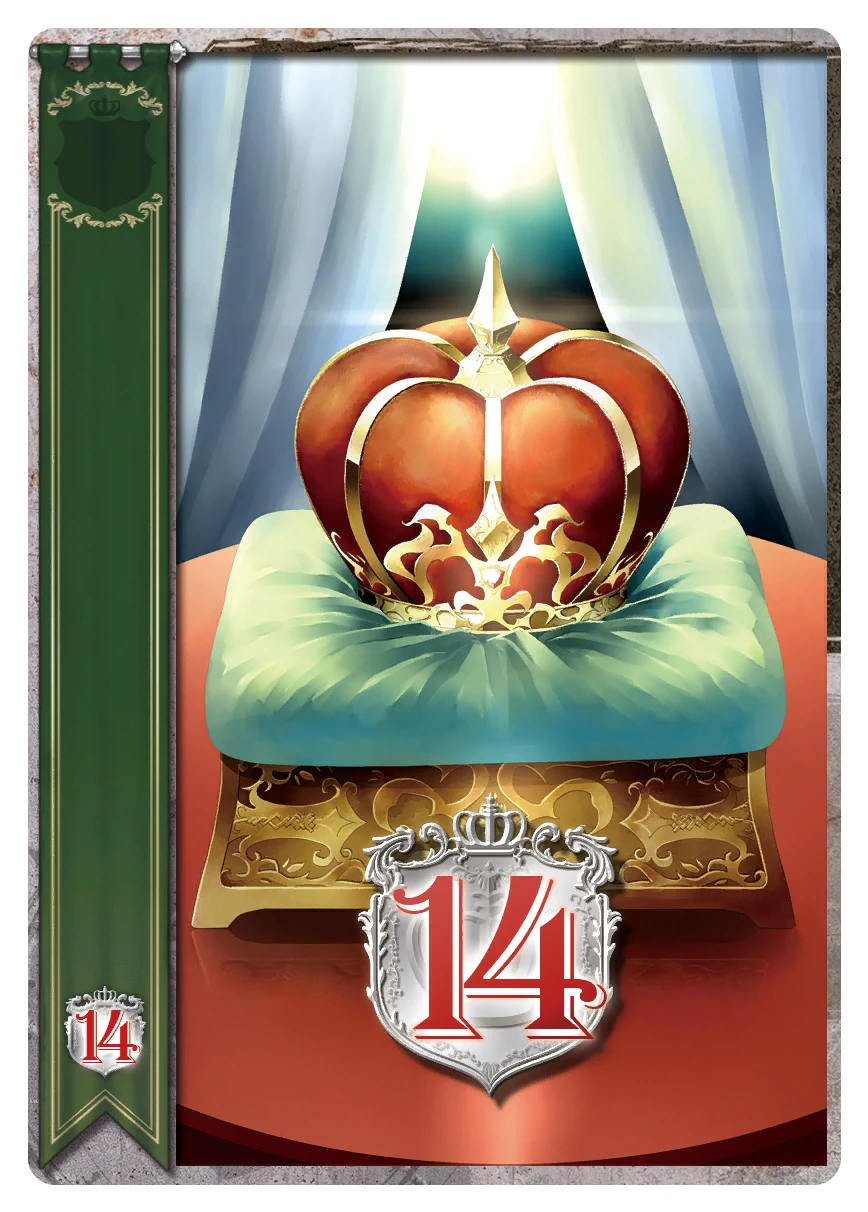

Goal of This Phase
After coronation, the only goal is collecting the most succession points as fast as possible.
Succession Point Priority Table
| Card | Cost | Points | Efficiency | Priority | When to buy |
|---|---|---|---|---|---|
| Duke | 8 | 6 | 0.750 | S | When you can reliably produce 8+ coins |
| Emperor's Crown | 13 | 14 | 1.077 | S (conditional) | With a very powerful deck producing 13+ coins |
| Senator | 5 | 3 | 0.600 | A | With 5-7 coin hands |
| Margrave | 6 | 3 (+special) | 0.500+ | A | When special effect can be leveraged |
| Handmaiden | 3 | 2 | 0.667 | B | When hand has 3 coins or fewer |
Practical priority:
- 8+ coins → Duke first
- 5-7 coins → Senator or Margrave
- 3-4 coins → consider Handmaiden
- 13+ coins → Emperor's Crown (best raw efficiency)
Multiple Card Purchase Conditions
| Hand coins | Maximum purchase combination | Max succession points |
|---|---|---|
| 5-7 | Senator × 1 (5 cost) | 3 pts |
| 8-9 | Duke × 1 (8 cost) | 6 pts |
| 10-12 | Duke + Handmaiden (8+3=11) | 8 pts |
| 13-14 | Duke + Senator (8+5=13) | 9 pts |
| 13+ | Emperor's Crown (13 cost) | 14 pts |
Succession Card Selection Theory
Complete Cost Efficiency Comparison
| Card | Cost | Points | Efficiency | Special | Overall |
|---|---|---|---|---|---|
| Handmaiden | 3 | +2 | 0.667 | None | B |
| Senator | 5 | +3 | 0.600 | None | A |
| Margrave | 6 | +3 | 0.500 | Yes | A+ (actual value higher) |
| Duke | 8 | +6 | 0.750 | None | S |
| Emperor's Crown | 13 | +14 | 1.077 | None | S+ (conditional) |
Why Duke is More Practical Than Emperor's Crown
Emperor's Crown seems overwhelmingly powerful at 14 points for 13 coins, but the difficulty of producing 13 coins in a single turn is the issue.
- Duke × 2 (16 cost, 12 points): Purchasable across 2 turns
- Emperor's Crown × 1 (13 cost, 14 points): Requires 13 coins in one turn
For most games, stacking Dukes delivers more consistent victory than attempting Emperor's Crown.
Optimal Purchases by Remaining Turns
| Remaining turns | Recommended priority | Reason |
|---|---|---|
| 10+ | Duke > Emperor's Crown > Senator | Prioritize long-term efficiency |
| 7-9 | Duke > Senator | Stack balanced points |
| 4-6 | Duke > Senator | Focus on high-efficiency options |
| 2-3 | Senator > Handmaiden | Prioritize affordable cost range |
| Final turn | Best card affordable | Don't waste available coins |
Game End Management
Understanding End Conditions
Game end occurs when:
- A player declares victory having reached the required succession point total
- Specific supply piles are depleted
Pile-Depletion Strategy
Deliberately emptying supply piles can force a game end in your favor when you hold the lead.
Valid conditions for this strategy:
- You have coronated first and hold a succession point lead
- Opponent's deck is weak and cannot respond with mass purchases
When Opponent Starts Collecting Succession Points
- Estimate opponent's maximum points per turn based on their deck strength
- Calculate the gap — current difference ÷ your per-turn advantage = turns needed to catch up
- Assess if you can catch up before game end — if not, consider accelerating game end
The 3-Pile Exhaustion Strategy
When 3 supply pile depletion ends the game, you can deliberately trigger this while holding a lead.
Execution:
- Confirm you hold a succession point lead
- Identify which 3 piles to target (cheap cards are best targets)
- Verify your deck can mass-purchase multiple types
- Execute mass purchasing
Warning: 3-pile exhaustion only benefits you if you are leading. Always verify your lead before triggering this.
Responding to Opponents
When You Coronate First
Lead coronation is a major advantage. After coronating first:
- Immediately begin succession point collection — buy succession cards every turn without fail
- Apply disruption if available — Curse Witch and Charm Witch pressure opponent's deck
- Manage game end conditions — maintain your lead by controlling when the game ends
Lead advantage by turn gap:
| Turn gap to opponent's coronation | Expected point lead |
|---|---|
| 1 turn ahead | ~6 points (1 Duke) |
| 2 turns ahead | ~12 points (2 Dukes) |
| 3 turns ahead | ~18 points (very hard to overcome) |
When Opponent Coronates First
Don't give up. Multiple comeback routes exist.
Response 1: Accelerate your own coronation 1-2 turns behind is absolutely recoverable with efficient play.
Response 2: Disrupt with attack cards
| Attack card | Cost | Effect | Effectiveness |
|---|---|---|---|
| Curse Witch | 5 | Distribute curses to opponent (pollutes deck) | Moderate (big in long game) |
| Charm Witch | 5 | Force opponent to discard action cards | High (immediate disruption) |
Response 3: Race with high-value succession cards Duke (6 pts) and Emperor's Crown (14 pts) let you close large gaps quickly.
Calculating Recoverable Point Gaps
| Gap | 5 turns remaining (Duke spam possible) | Recoverable? |
|---|---|---|
| 6 pts | You: +30 vs Opponent: +26 (net +4/turn advantage) | Yes |
| 12 pts | You: +30 vs Opponent: +32 (gap doesn't close) | Difficult |
| 18 pts | You: +30 vs Opponent: +38 | No (special measures needed) |
Victory Route by Princess
All Princess Comparison Table
| Princess | Rating | Coronation bonus | Key strategy | Optimal playstyle |
|---|---|---|---|---|
| Laoriri | S | Gain up to 5 Handmaidens | Economy explosion at coronation | Removal-heavy, slightly later coronation |
| Rurunasvika | A | None (+6 pts base) | Reliable, simple economy building | Early coronation advantage |
| Flamaria | A | Economic/score acceleration | Maximize special effect | Prepare to activate effect |
| Cramcram | A | Unique score/action effect | Set up conditions early | Planned construction |
| Bergamot | — | Moderate bonus | Flexible | Adaptive |
| Rain & Sion | B | Defensive/control | Disrupt opponent | Long-game disruption |
Advanced Player Thought Process
Per-Turn Calculations
Every turn, advanced players run the following calculations:
At turn start (after drawing):
- Calculate total coins available this turn
- Determine what can be purchased (narrow options instantly)
- Decide optimal action card play order
Before buy phase: 4. Question whether the planned purchase is truly optimal 5. Consider how the new card will affect future draw probability
During opponent's turn: 6. Estimate opponent's deck size from their discard pile 7. Evaluate threat level for next opponent turn
Reading the Opponent's Deck
| What to observe | Information gained |
|---|---|
| Opponent's discard pile size | Deck size estimate (pile × 2 ≈ total deck) |
| Cards opponent purchased | Deck strength and strategy direction |
| Hand size variations | Draw card presence and usage patterns |
| Speed of buy phase decisions | Strong deck (buys quickly) vs weak (hesitates) |
| Turns without purchasing | Insufficient coins — deck weakness signal |
Victory Checklist
Phase 1 Checklist (Turns 1-5)
| Check item | Good | Needs improvement |
|---|---|---|
| Estate count | 4 or fewer | 6-7 remaining |
| City count | 1-2+ | 0 |
| Deck size | 12 or fewer | 15+ |
| Princess status | Purchased or planned | Not purchased, no plan |
| Expected coins/turn | 5+ | 4 or fewer |
Phase 2 Checklist (Turns 6-12)
| Check item | Good | Needs improvement |
|---|---|---|
| Grand City count | 1-2+ | 0 |
| Deck coin density | 1.8+ | 1.5 or lower |
| Estate count | 3 or fewer | 5+ |
| Coronation readiness | 12-coin turns are realistic | No prospect |
| vs Opponent | Even or slightly behind | Far behind |
Phase 3 Checklist (After Coronation)
| Check item | Good | Needs improvement |
|---|---|---|
| Avg succession pts/turn | 5+ | 3 or fewer |
| Succession point lead | Leading | Even or trailing |
| Game end awareness | Managed | Passive |
| Remaining turn calculation | Active | Not considered |
| Counter to disruption | Prepared | No plan |
Summary: Three Simple Steps to Victory
No matter how complex Heart of Crown appears, the path to victory comes down to three simple steps:
Step 1: Thin your deck by removing Estates Early estate removal increases deck density and stabilizes your economy.
Step 2: Coronate at the right moment Watch your opponent and coronate "not too late, not too early."
Step 3: Collect succession points every turn after coronation Maximize per-turn succession point gains and reach the victory threshold before your opponent.
| Step | Key action | Target |
|---|---|---|
| Step 1 | Estate removal (Donation) | Remove down to 3 or fewer Estates |
| Step 2 | Coronation (assemble 12 coins) | Complete by around turn 10 |
| Step 3 | Buy succession cards | Gain 5+ points per turn |